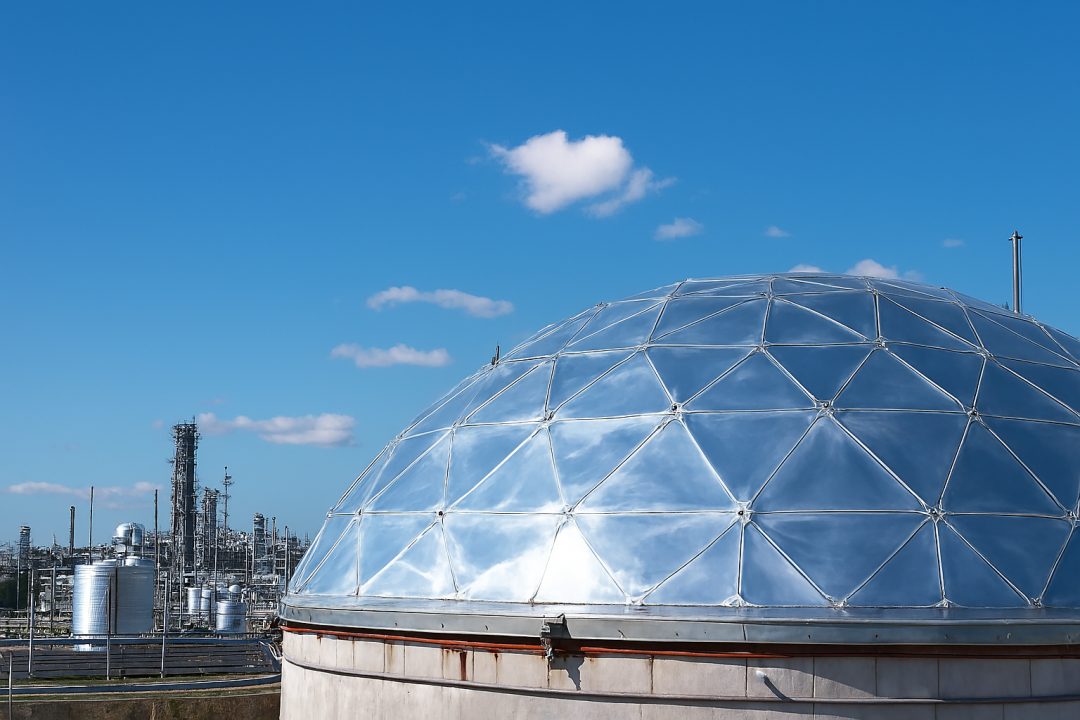
Far from being just an architectural curiosity, the geodesic dome is one of the most structurally efficient solutions known to humanity. Today, I want to break down its “reason for being” not from an architect’s perspective, but through the lens of structural mechanics and materials engineering.
1. The Fundamental Principle: Strength Through Stress Distribution
In the oil and gas industry, we design equipment and piping to withstand colossal pressures, both internal and external. The key is never to confront that force with sheer mass alone, but to distribute it intelligently so that no single point becomes the weak link.
A geodesic dome does exactly this. Loads (wind, snow, self-weight) are not concentrated on a few beams, as in traditional structures. Instead, they are evenly distributed across the entire network of interconnected triangles.
Petroleum analogy: Think of the pressure vessel shell of an oil and gas separator. It is designed so that internal pressure is distributed uniformly across the surface, preventing localized stress concentrations. The geodesic dome is the architectural equivalent of this principle—but for external loads.
2. Material Efficiency: Less Is More (and Stronger)
In offshore projects, every ton of steel transported offshore represents a significant cost. Material efficiency is not optional—it is both an economic and safety imperative. Geodesic domes are the epitome of such efficiency.
The triangular configuration is inherently rigid. A triangle does not deform under load unless its sides are compressed or stretched. By forming a hemispherical structure composed entirely of triangles, an incredibly strong and stable framework is achieved using a fraction of the material required by a concrete dome or a conventional roof of similar span.
Petroleum analogy: This mirrors the principle behind drilling derricks and offshore platform jackets. These lattice structures, composed of interconnected triangles, achieve tremendous height and strength with relatively low weight, while resisting dynamic wind and wave forces.
3. Surface-to-Volume Ratio: The Geometry of Performance
This is where the analysis becomes particularly compelling. A sphere has the lowest surface-to-volume ratio of any geometric shape. This means that to enclose a large volume, the least possible surface area—and therefore material—is required.
For a petroleum engineer, this is highly relevant. In fluid transport, minimizing surface area reduces heat loss and energy inefficiency. A geodesic dome, by approximating a sphere, maximizes usable interior space while minimizing the surface exposed to environmental elements (cold, heat, wind). The result is superior thermal efficiency for heating and cooling.
4. Resistance to Dynamic Loads: The “Fracturing” Force of a Hurricane
Structures in the Gulf of Mexico must withstand hurricanes; in northern climates, they must endure heavy snow loads. A geodesic dome excels under such dynamic conditions. Its aerodynamic shape allows wind to flow around it rather than impact a flat façade, as would occur with conventional buildings.
Snow loads are distributed similarly to formation pressure acting on a well casing string: uniformly, directing stresses along the structure and transferring them efficiently to the base, where they are safely dissipated into the ground.
Conclusion: An Elegant Solution to a Complex Problem
Ultimately, the raison d’être of the geodesic dome can be summarized in a concept every petroleum engineer reveres: structural integrity. It is the embodiment of engineering elegance—where form follows function in the most efficient way possible.
It is not merely an aesthetically pleasing shape; it is a geometric response to the challenge of creating a shelter, space, or enclosure that is exceptionally strong, efficient, and logically sound. It serves as a reminder that the most powerful engineering solutions are often achieved not through greater force, but through greater intelligence.