Industrial process safety is a fundamental pillar in ensuring worker integrity, operational continuity, and environmental protection. In environments where hazardous substances, heavy machinery, or extreme conditions are present, identifying and controlling risks is a critical task. One of the most effective tools to achieve this is the Task Risk Analysis (TRA), also known as Job Hazard Analysis (JHA).
What is a TRA or JHA?
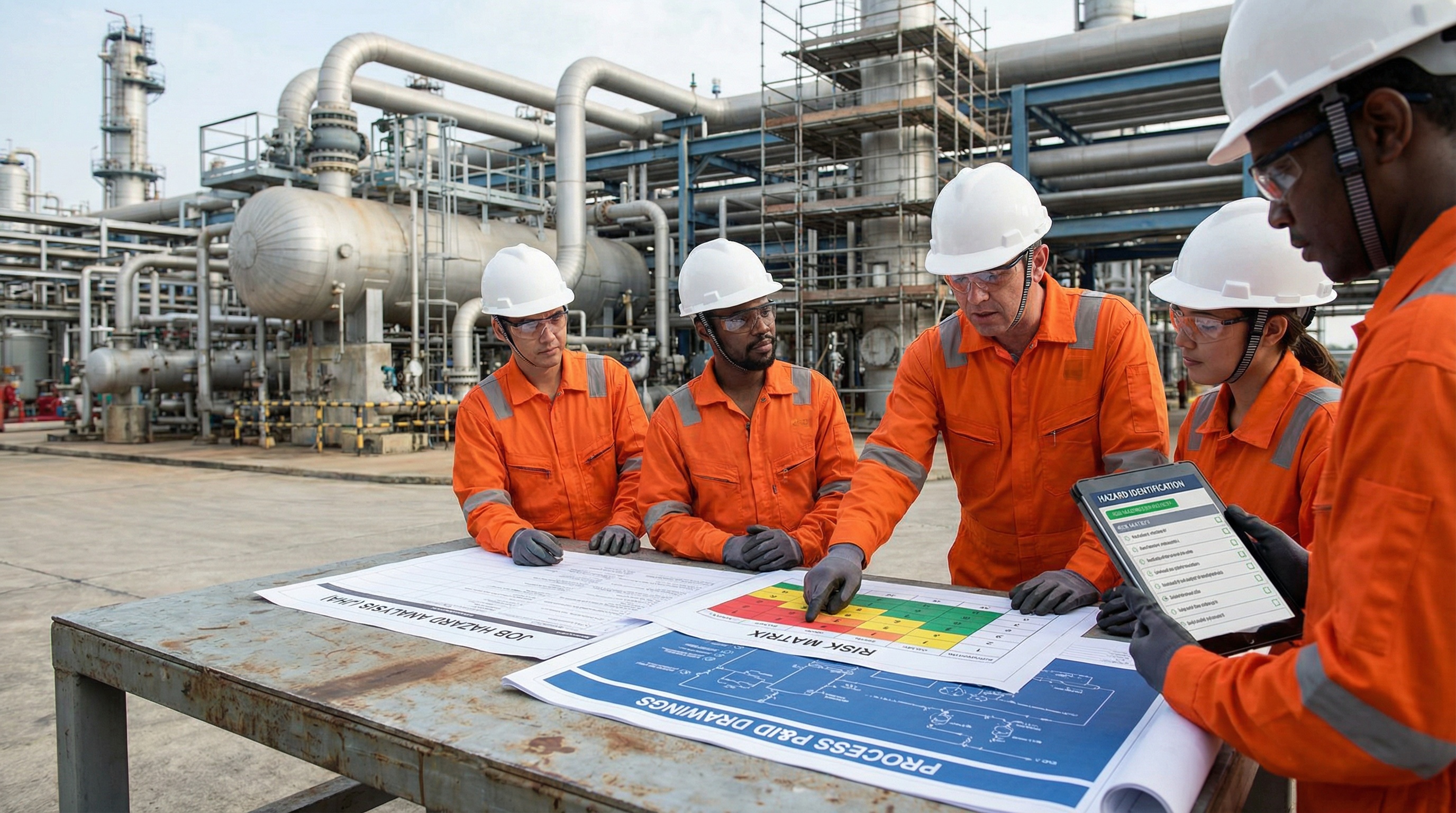
A TRA is a systematic methodology used to identify hazards associated with a specific task before it is performed. Its primary objective is to prevent accidents by evaluating work steps, identifying risks, and implementing appropriate controls.
Why is it important?
• Accident prevention: By anticipating hazards, preventive measures can be implemented before incidents occur.
• Worker protection: Reduces exposure to unsafe conditions.
• Improved efficiency: A safe work environment enhances productivity.
• Regulatory compliance: Supports compliance with regulations such as OSHA, INPSASEL, and other local standards.
Steps to conduct an effective TRA
- Select the task: Choose a critical or high-risk activity.
- Break down the task: Divide it into sequential steps.
- Identify hazards: Analyze each step for physical, chemical, ergonomic, or other risks.
- Assess risks: Determine the likelihood and severity of each hazard.
- Establish controls: Implement engineering, administrative, or personal protective measures.
- Communicate and train: Ensure all involved personnel understand the analysis and the adopted controls.
Practical example
Task: Replacing a valve in a steam line.
• Step: Isolate the line.
◦ Hazard: Burns from residual steam.
◦ Control: Pressure verification and use of thermal PPE.
• Step: Remove the old valve.
◦ Hazard: Struck-by or pinch injuries.
◦ Control: Proper tools and direct supervision.
Best practices
• Conduct a TRA before every non-routine task.
• Involve operational personnel in the analysis process.
• Periodically review and update TRAs.
• Integrate TRA into the company’s safety culture.
Task Risk Analysis is not merely a document—it is a living tool that saves lives. Adopting it as an integral part of industrial safety management represents an investment in well-being, efficiency, and social responsibility. In a world where safety is non-negotiable, TRA is one of our strongest defenses.